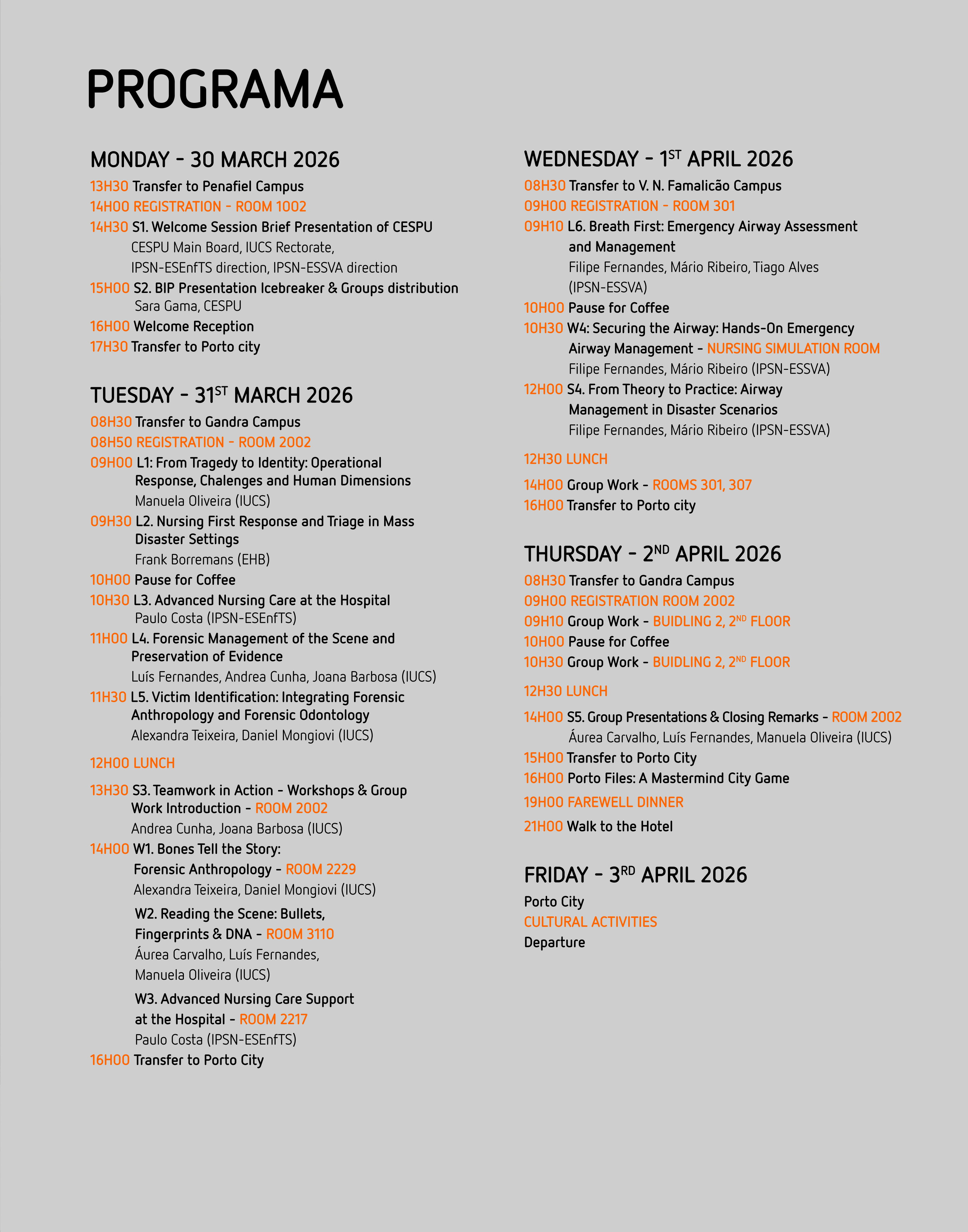
BRIDGING FORENSIC AND NURSING SCIENCES IN DISASTER RESPONSE AND RECOVERY (2025/2026)
PROGRAMME DESCRIPTION
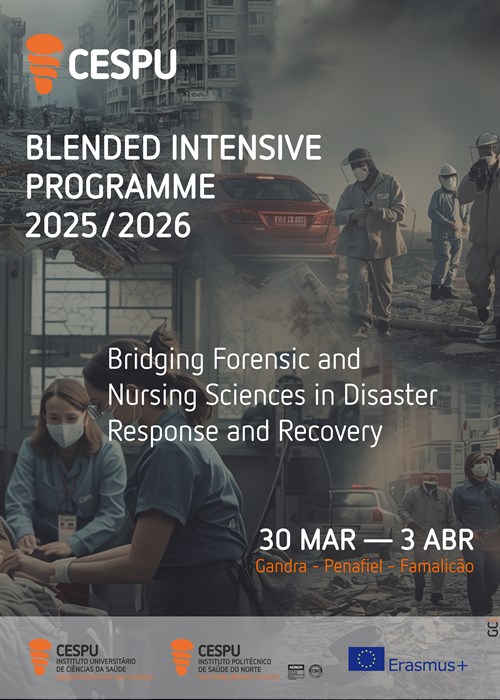
Bridging Forensic and Nursing Sciences in Disaster Response and Recovery is a 3 ECTS Blended Intensive Programme focused on interdisciplinary intervention in mass disaster situations.
The programme integrates Nursing and Forensic Sciences perspectives, addressing the full disaster response cycle - from preparedness and field response to victim care, forensic investigation, and recovery.
Through a combination of online preparatory work, lectures, hands-on workshops, interactive simulations, and group exercises, students will acquire both theoretical knowledge and practical skills essential for effective disaster intervention. The programme promotes interprofessional collaboration, ethical awareness, and evidence-based decision-making in high-pressure contexts.
SILENT THREAT - TACTICAL, FORENSIC, AND MEDICAL SIMULATION OF A POISONING CASE (2024/2025)
PROGRAMME DESCRIPTION
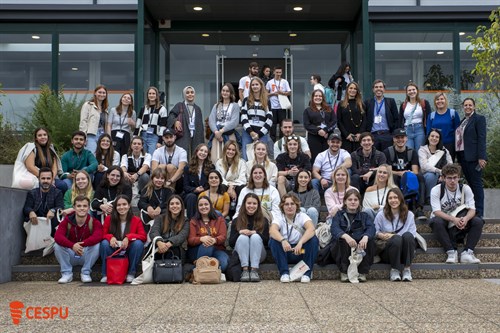
This Blended Intensive Programme aims to provide an immersive academic experience for students of Forensic Science, Nursing, and Biomedical Sciences through the simulation of a complex case that will require collaboration, problem-solving, critical thinking, and application of their academic knowledge.
Students will work in interdisciplinary teams, allowing them to gain practical skills in forensic investigation and emergency response. Focusing on emergency response during a critical incident requires a delicate balance between saving lives and preserving forensic evidence. The initial priority is to stabilize victims and provide first aid, ensuring their survival. At the same time, professionals must be mindful of preserving the incident scene for forensic investigation, avoiding the compromise of evidence such as biological traces, toxic substances, or physical objects that may be crucial in determining the causes and circumstances of the event. This balance is essential for effective response and successful investigation. By involving Portuguese police forces and emergency teams in the simulation activity, students will gain a better understanding of how these interventions are organized in real-life scenarios.
Additionally, students will have to reconstruct the sequence of events using data from various sources, including toxicology reports, microbiological findings, and psychiatric assessments of the individuals involved. This process will encourage them to analyze complex information, draw conclusions, and propose hypotheses about the incident.
Finally, students will learn how to write detailed forensic reports with their findings and analyses. These reports are fundamental as they may be used as evidence in judicial proceedings. The simulation will emphasize the importance of clarity, precision, and objectivity in report writing, key skills for future careers in forensic investigation, healthcare, and biomedical research.
+ INFO
EMAIL: erasmus@cespu.pt
TELEPHONE: (00351) 224 157 200/202